
01
ISO 9001
Quality Management System
A framework for consistent quality, customer satisfaction and continual improvement across your operations.
How it works
A clear, structured path from understanding your requirements to achieving and maintaining certification.
Step 01
Identify the right ISO standard and understand the requirements relevant to your organization.
Step 02
Evaluate existing processes, policies, controls and practices to identify gaps against the chosen standard.
Step 03
Develop the required policies, processes and controls and put them into practice across the organization.
Step 04
Review evidence, address gaps and prepare for the certification audit with confidence.
Step 05
Continue monitoring, improving and maintaining your management system beyond initial certification.
Certification & Attestation
Both lead to the same outcome: evidence a buyer, a regulator or your board will accept. Which one applies depends on the standard, not on how much work you put in.
An accredited certification body audits your management system against the standard, in a Stage 1 readiness review followed by a Stage 2 audit.
What you hold
A certificate on a three-year cycle, kept current by annual surveillance audits.
An independent practitioner examines how your controls were designed and whether they operated across a reporting window — or, where a regulation applies rather than a certifiable standard, we scope what you are subject to and show where the gaps sit.
What you hold
A Type II report covering six to twelve months, or a gap report with a remediation roadmap.
Audited by an accredited certification body.
ISO 9001
A framework for consistent quality, customer satisfaction and continual improvement across your operations.
ISO/IEC 27001
The global benchmark for establishing, operating and continually improving an ISMS across people, process and technology.
ISO/IEC 27701
A privacy extension to ISO/IEC 27001 that maps directly to controller and processor responsibilities.
ISO/IEC 20000-1
Service management certification covering the full service lifecycle from design to continual improvement.
ISO 22301
Certification for planning, preparing for, and recovering from disruptive incidents that threaten operations.
ISO/IEC 42001
Certification for the responsible design, development, deployment and monitoring of AI management systems.
Guidance standards that extend a certified ISMS, generally audited alongside it in the same visit.
ISO/IEC 27017
Cloud-specific guidance layered on ISO/IEC 27002 covering shared responsibility between cloud provider and cloud customer.
ISO/IEC 27018
Protection of personally identifiable information processed in public cloud environments acting as a PII processor.
ISO/IEC 27032
Guidance for coordinating cybersecurity practices across information security, network security and internet safety.
ISO 27031
Guidance for ensuring ICT services can be recovered to support business continuity objectives.
Examined by an independent practitioner over a reporting window, or assessed against the regulation or scheme as written.
SOC 1 Type II
Independent attestation over controls relevant to a service organisation's impact on client financial reporting.
SOC 2 Type II
Attestation against security, availability, confidentiality, processing integrity and privacy criteria.
PCI DSS
Assessment against the Payment Card Industry Data Security Standard for organisations handling cardholder data.
GDPR
Regulatory readiness assessment against the EU General Data Protection Regulation for controllers and processors.
PDPA
Regulatory readiness assessment against applicable Personal Data Protection Act requirements.
HIPAA
Readiness assessment against HIPAA privacy and security safeguards for protected health information.
Certifications & Compliance
Global standards. Stronger organizations.
A safer tomorrow.
01
Build Trust
With globally recognized standards
02
Strengthen Security
Reduce risk and improve resilience
03
Enable Growth
Open doors to new opportunities
Step towards
a more trusted
future
Build robust management systems for long-term resilience.
Industries


Certification Readiness
Answer 10 quick questions to get a general view of which common certification preparation areas are currently in place and which may need further review.
Questions reviewed
0 / 10
Several common preparation areas are still to be reviewed.
Question 01 of 10
Certification Stages
Understand the key stages through which your management system is reviewed, assessed and taken through the certification process.
Scope & Readiness Review
STAGE 01 / Certification Process
The certification application, management system scope and relevant documentation are reviewed to establish the basis for the certification assessment.
A clear starting point for the certification journey.
Certification is not the finish line. Periodic surveillance audits help verify that the management system continues to conform to applicable requirements and remains effectively implemented.
Maintain. Improve. Demonstrate continued conformity.
WHY CERTANIKA
A structured, transparent and supportive approach designed to help organizations move through their certification journey with greater clarity and confidence.
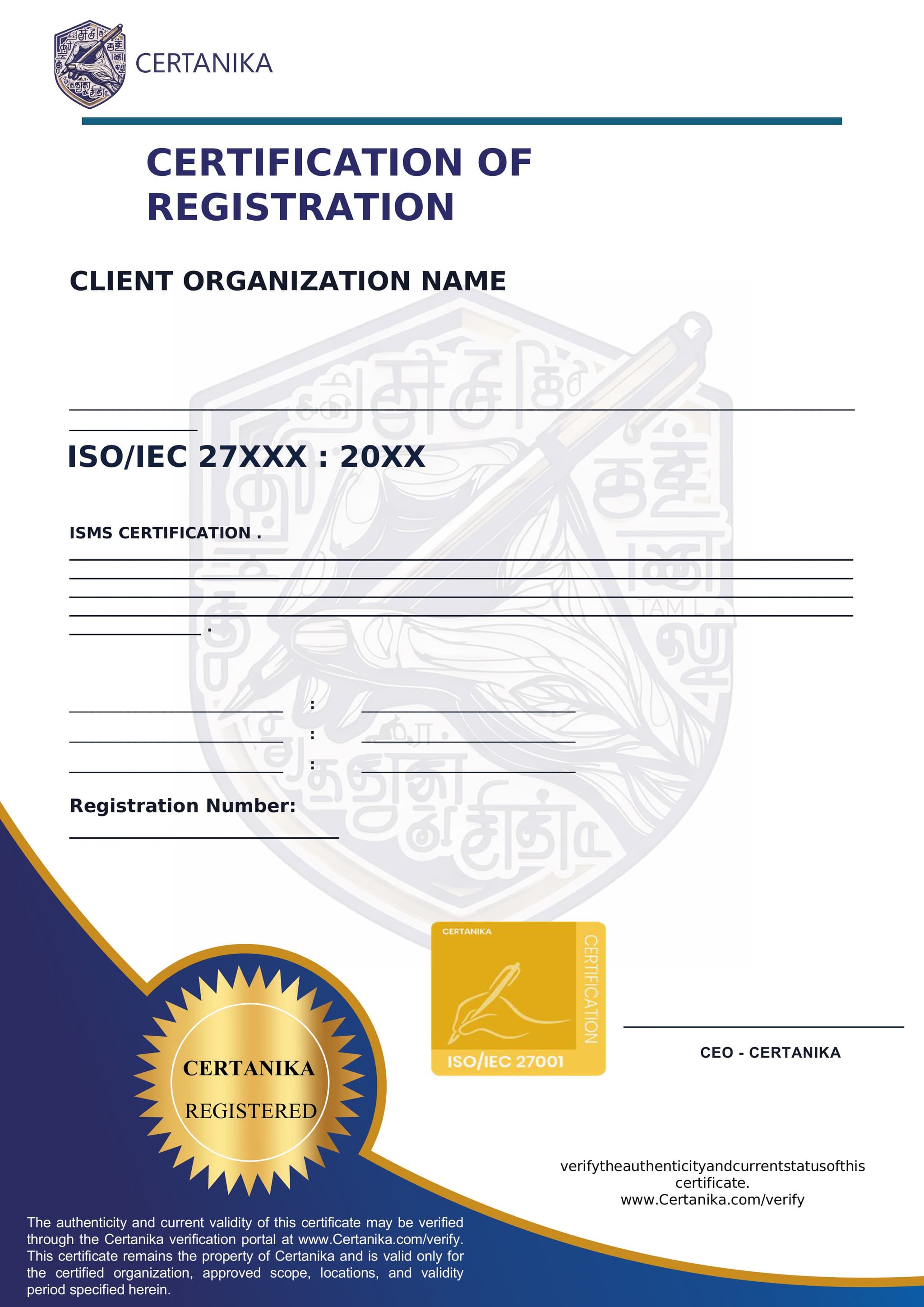
A clear path from preparation through the certification journey.
Focused on real implementation, not documentation alone.
Clear support and direction at each important stage.
Support that continues beyond the initial certification milestone.
AFTER CERTIFICATION
Certification marks an important milestone, but maintaining and improving the management system continues throughout the certification lifecycle.
01
Keep the management system, processes, responsibilities and controls implemented and operating as intended.
02
Track objectives, performance, risks, changes and relevant management-system indicators on an ongoing basis.
03
Use audit findings, performance results and corrective actions to strengthen and continually improve the management system.
04
Support periodic surveillance audits by maintaining effective implementation and demonstrating continued conformity.
05
Review system effectiveness, address gaps and prepare for the next certification cycle and recertification audit.
A strong management system keeps evolving beyond the certification decision.
Maintain. Monitor. Improve. Stay prepared.
Take the next step with a structured certification approach designed to help your organization prepare with clarity and confidence.